




As we reach our mid-50s, many of us face the dual challenge of cataracts clouding our lenses and presbyopia limiting our ability to focus on nearby objects. This creates a frustrating cycle of swapping between reading glasses for menus and smartphones, and distance glasses for driving and television, leaving many feeling trapped by their dependence on multi-pair eyewear. So, what’s the solution that 22-34% of patients choose? Monovision cataract surgery. This vision correction technique uses intraocular lenses (IOLs) to give you the best of both worlds: clear distance vision in one eye, and comfortable near vision in the other. Curious if it’s the right fit for you? Learn about the technique, who is the best candidate, long-term considerations, and the answers to your questions.
How Does Monovision Differ From Traditional Cataract Surgery?
During traditional cataract surgery, your surgeon removes your cloudy natural lens and replaces it with a standard IOL that is tuned for distance vision. While this provides excellent clarity for far-off activities, it typically requires reading glasses for close-up tasks like texting or reading. With monovision cataract surgery, your surgeon completes the surgery as normal, but the IOLs inserted have different focal points: your dominant eye is fine-tuned for distance vision, while your non-dominant eye is for near-vision.
Why Does Monovision Work So Well?
After monovision, your brain undergoes neuroadaptation, rewiring and relearning to automatically select the eye with the clearest image for each task. Here’s how it works:
- Smart Filtering: Your brain naturally ignores “noise” through a process called binocular rivalry resolution, allowing your visual cortex to prioritize the sharpest signal and suppress the blurrier image.
- A Synchronized Team: Your brain’s two halves are connected by the corpus callosum, which acts like a high-speed data cable. Even if your right eye is focused on the horizon and your left on a text message, this connection ensures both sides work as a synchronized team.
- Automatic Routing (Task-Specific Selection): Your primary visual cortex (V1) actually “learns” a new set of directions. It routes distance signals to your dominant eye’s pathways and near-vision signals to your non-dominant eye’s pathways, all without you having to think about it.
- High-Speed Switching: Thanks to a neural reflex called feedforward inhibition, the “switch” from one eye to the other happens in about 100–200 milliseconds, creating fluid vision transitions that are too fast for your conscious mind to notice.
The Result? Within 2 to 8 weeks, these new neural connections become “hardwired,” creating a seamless, blended focus range. For those concerned about the adjustment period, modern ‘Mini-Monovision’ offers an even gentler transition (more on that below).
Who Is a Good Candidate for Monovision Cataract Surgery?
The most successful monovision cataract surgery candidates share characteristics that predict excellent adaptation and long-term satisfaction:
- Active individuals over 50 who want seamless visual transitions between reading menus, using smartphones, and driving without constantly changing glasses.
- Previous monovision contact lens users who successfully adapted to this vision strategy are the “gold standard”. Clinical data show they demonstrate a 90-95% surgical success rate because their neural pathways are primed for blended vision.
- Patients with realistic expectations who understand that occasional reading glasses may still be helpful for fine print or extended reading sessions.
- Those seeking cost-effective presbyopia correction since standard monofocal IOLs used in monovision are typically covered by Medicare and insurance.
- Individuals with good overall eye health and minimal complications like severe dry eye or significant astigmatism (easily correctable with toric IOLs).
Overall Success Rates: For the general population, monovision cataract surgery is remarkably reliable. Recent studies show it works successfully in 86-96% of properly selected cases.
What Happens Before & During Monovision Cataract Surgery?
You’ll have a consultation beforehand where your surgeon will develop a personalized monovision strategy tailored to your eyes and lifestyle preferences. In this planning phase, precise measurements of your eye’s dimensions are taken, your dominant eye is identified, and a 1-2 week monovision contact lens trial is completed to make sure your eyes can adapt.
How Is It Performed?
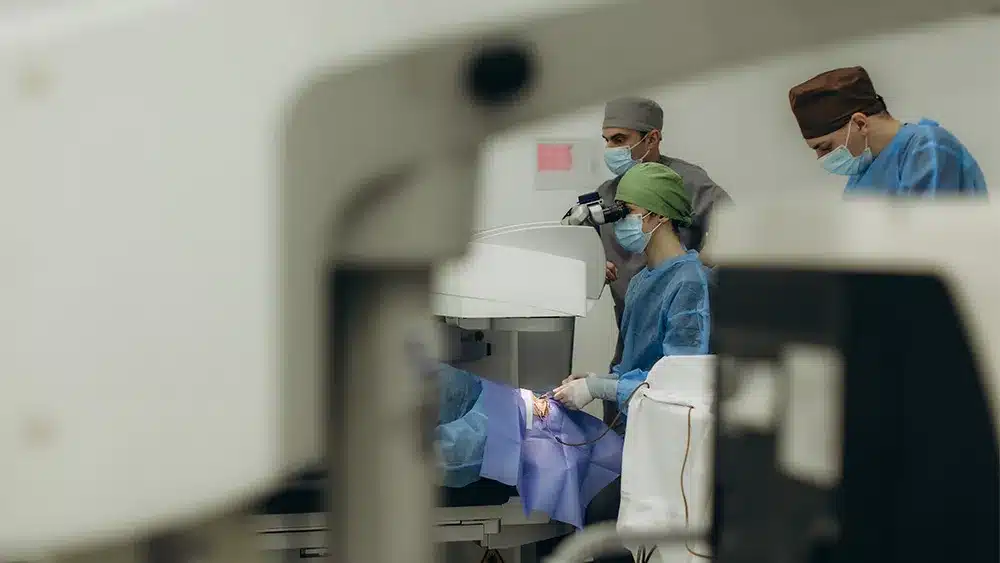
Monovision cataract surgery follows the same proven safety protocol as standard cataract surgery, with strategic IOL selection:
- Anesthesia: Topical numbing drops ensure complete comfort during the 15-20 minute procedure.
- Corneal Incision: A precise 2-3mm self-sealing incision is created in the clear cornea.
- Lens Fragmentation: Ultrasound energy (phacoemulsification) gently breaks up the cloudy natural lens.
- Lens Removal: Microscopic suction removes all lens fragments while preserving the lens capsule.
- IOL Implantation: The surgeon carefully unfolds and positions your customized IOL within the natural lens capsule.
- Final Positioning: Precise IOL alignment ensures optimal focus for your eye’s designated distance role.
How Does Monovision Compare to Other Cataract Surgery Options?
Learning how monovision compares to multifocal IOLs and standard approaches can clarify which option suits your visual needs, lifestyle, and budget.
| Feature | Monovision Strategy | Multifocal IOLs | Standard Monofocal |
|---|---|---|---|
| Distance Vision | Excellent in the dominant eye | Good binocularly | Excellent binocularly |
| Near Vision | Good in the non-dominant eye | Excellent binocularly | Requires reading glasses |
| Night Vision | Minimal halos or glare | Possible halos/glare | Excellent clarity |
| Insurance Coverage | Usually fully covered | Premium upgrade cost | Fully covered |
| Adaptation Period | 2-8 weeks | 1-3 months | Minimal adjustment |
| Success Rate | 86-96% in ideal candidates | 85-95% | Near 100% for distance |
What Are The Disadvantages of Monovision Cataract Surgery?
While most patients love their monovision results, knowing about the disadvantages of monovision cataract surgery’s adjustment period can help clarify expectations:
- Depth Perception Changes: Some patients notice temporary changes in stereoscopic vision during the first few weeks, especially for tasks requiring sharp depth perception like threading needles, playing competitive sports, or judging distances while parking.
- Night Vision Adjustments: You may initially see mild halos around lights during night driving, which typically diminish as neuroadaptation occurs.
- Fine Print Limitations: While 85-90% of daily activities become glasses-free, you may occasionally prefer reading glasses for very small print, detailed crafts, or extended reading sessions in low lighting.
- Professional Demands: Certain professions requiring exceptional depth perception (commercial pilots, surgeons) may need special consideration, though most occupations are compatible with monovision.
The Mini-Monovision Advantage: For patients sensitive to traditional monovision differences, mini-monovision offers an excellent alternative using smaller power differences (1.0-1.5 diopters) between eyes. This refined approach enhances comfort and offers gentler adaptation during the adjustment period while maintaining excellent functional vision for daily activities.
FAQ About Monovision Cataract Surgery
Here are common questions patients ask about monovision cataract surgery, along with expert answers to guide your decision.
- What Does Recovery From Monovision Cataract Surgery Look Like? Recovery progresses through distinct phases: initial healing with some vision changes in week 1, improved visual balance during weeks 2-4, complete physical healing by weeks 5-8, and full neuroadaptation within 3 months.
- Will I Still Need Reading Glasses? Most patients achieve excellent functional vision without glasses for daily activities like reading newspapers, using smartphones, and working on computers. But, you may want reading glasses for very fine print or extended reading sessions.
- Can Monovision Be Adjusted If I’m Not Satisfied? Yes, monovision can be modified through enhancement procedures, although this is rarely needed.
Your Clear Path to Visual Freedom Starts With Expert Guidance
Don’t let cataracts and presbyopia control your routine. Monovision cataract surgery has helped thousands achieve glasses-free living through a time-tested, often insurance-covered approach. At Best Cataract Surgeons, our network of specialists combines technical excellence with personalized care to optimize your results. Discover if monovision is right for you by connecting with a top cataract surgeon today.
About the Author Written by Dr. Michael Shumski, M.D., M.S.E.

Dr. Shumski is a board-certified ophthalmologist specializing in cataract & refractive surgery at Magruder Laser Vision in central Florida.