



Are you someone who’s been struggling with blurry or distorted vision from both cataracts and astigmatism? You might be asking, “Will cataract surgery correct my astigmatism?” The truth is, modern cataract surgery is much more than just swapping out a cloudy lens. Thanks to advances in surgical techniques and specially designed lens implants, this surgery often tackles both issues at once, removing your cataract and reshaping your cornea to reduce or eliminate astigmatism. For many patients, this means clearer vision and less dependence on glasses, turning what used to be a simple procedure into a chance for a brighter, sharper future.
What Is Cataract Surgery?
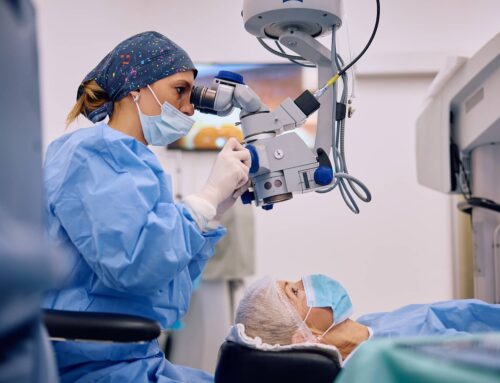
Cataract surgery is a highly refined outpatient procedure that removes the eye’s cloudy natural lens and replaces it with a clear artificial intraocular lens (IOL). Modern small-incision techniques and advanced lens technology make it one of the safest and most successful surgeries performed in medicine today. For many patients, this is also an opportunity to reduce dependence on glasses by addressing other vision problems like nearsightedness, farsightedness, and astigmatism.
Did You Know? Modern cataract surgery takes 15-20 minutes per eye, and most patients return to light activities like reading, television, walking, and showering within 24-48 hours. Read more about the recovery in our Cataract Surgery Post-Op Care Guide – What to Expect and How to Recover Well.
What Is Astigmatism and How Does It Affect Cataract Surgery?
Astigmatism occurs when the cornea (the clear front window of the eye) is shaped more like a football than a basketball, causing light to focus at different points instead of a single sharp focus. This can lead to blurred or distorted vision at distance and near, even if cataracts are also present. Astigmatism prevalence increases with age: 23.1% in ages 20-39, 27.6% in ages 40-59, and 50.1% in those 60 and older, making it relevant for cataract surgery patients. Many adults over 50 have at least a mild amount of astigmatism, and uncorrected astigmatism after cataract surgery can still require glasses for crisp vision.
Why Correct Cataracts and Astigmatism At The Same Time?
Correcting astigmatism during cataract surgery is often the most efficient and precise way to improve overall visual quality:
1. Astigmatism Can Limit Post-Surgery Results.
If untreated, astigmatism may leave vision blurred or shadowed even after cataract removal. Many patients are surprised they may still need distance glasses after standard cataract surgery if their astigmatism isn’t addressed.
2. Improved Quality of Life and Independence.
Reducing astigmatism can provide sharper distance vision, better night driving, and enhance reading comfort, often with less dependence on glasses. Studies show 88% of Toric IOL patients achieved 20/25 vision or better after surgery, with many reporting greater satisfaction compared to patients without the dual astigmatism-cataract correction.
3. Reduced Risk of Falls and Visual Strain.
Clearer, stable vision improves depth perception, contrast, and the ability to recognize steps and curbs, benefiting senior adults prone to falls and injuries. Minimizing visual distortion may also decrease eye strain and headaches from uncorrected refractive error.
How Will Cataract Surgery Fix My Astigmatism? Mainstream Techniques Used
Your cataract surgeon will choose one of the primary techniques below based on your specific level of astigmatism and eye anatomy:
For Mild Astigmatism (Less Than 1.0 Diopter).
- Limbal Relaxing Incisions (LRI): Tiny, precisely placed arc-shaped cuts near the cornea’s outer edge will gently flatten the steep curve and reduce astigmatism. These can be made manually or with a femtosecond laser for enhanced accuracy.
- Clear Corneal Incision on the Steep Axis: By placing the main surgical incision along the steepest part (meridian) of your cornea, surgeons can induce controlled flattening to reduce low levels of astigmatism.
For Moderate to High Astigmatism (1.0+ Diopters).
- Toric lenses are specially designed to correct astigmatism and work best for moderate to severe cases. They’re like prescription glasses built into your eye—they have different focusing powers in different directions to match your eye’s shape. During surgery, your surgeon carefully positions the toric lens to cancel out your cornea’s irregular curve. These lenses can correct 0.75 to 4.75 diopters of astigmatism, covering most patients’ needs.
If Additional Fine-Tuning Is Needed: Excimer laser procedures (LASIK or PRK) can be performed weeks after cataract surgery to fine-tune residual astigmatism.
After Cataract Surgery and Astigmatism Correction, Does Long-Term Vision Improve?
Yes, astigmatism correction during cataract surgery provides long-lasting vision improvement. Studies following patients for 8 years show sustained effects of Toric IOLs. Additionally, 95% of patients achieved spectacle independence for distance vision and 79% for near vision when astigmatism was corrected. For patients in their 60s and 70s, this represents lifetime visual benefits, as IOLs are designed to be permanent.
Your Clear Path to Better Vision Starts Here At Best Cataract Surgeons
Addressing both cataracts and astigmatism together isn’t just about convenience; it’s about maximizing your visual potential while you have the opportunity. With today’s advanced toric lens technology and precision surgical techniques, you can transform a necessary cataract procedure into a comprehensive vision upgrade. The key is choosing a surgeon with extensive experience in astigmatism correction who can evaluate your eye anatomy and recommend the best approach for you. Connect with a top-rated cataract surgeon in your area to explore your options and discover what clearer vision could mean for your future.
About the Author Written by Dr. Michael Shumski, M.D., M.S.E.

Dr. Shumski is a board-certified ophthalmologist specializing in cataract & refractive surgery at Magruder Laser Vision in central Florida.